

How to Choose the Right Video Conferencing Solution for Your Company in 2026
Hayley Spooner, Jun 1, 2026

Key takeaways
- The best video conferencing solutions in 2026 are integrated collaboration ecosystems that combine hardware, software, AI, cloud management, and workflow integrations.
- Organizations should evaluate conferencing solutions based on how employees actually work rather than focusing solely on product specifications.
- Simplicity has become a major differentiator, with intuitive, easy-to-use systems driving higher adoption and better meeting experiences.
- Audio quality remains the most important factor in meeting effectiveness, often having a greater impact on collaboration than video quality alone.
- AI-powered capabilities such as automatic framing, transcription, meeting summaries, and intelligent noise suppression are becoming standard expectations.
- Interoperability is essential as organizations increasingly rely on multiple collaboration platforms, including Microsoft Teams, Zoom, and Google Meet.
- Centralized management and analytics help IT teams scale deployments, reduce operational complexity, and improve long-term performance.
- Meeting equity is emerging as a key measure of conferencing success, ensuring remote and in-room participants can engage equally.
- The most successful organizations focus on creating seamless collaboration environments where technology fades into the background and meetings happen naturally.
Choosing the right video conferencing solution is no longer just an IT purchasing decision. In 2026, video conferencing has become part of the core infrastructure that supports how organizations communicate, collaborate, and operate across distributed teams. The systems companies choose now directly influence productivity, employee experience, meeting quality, operational efficiency, and the success of hybrid work itself.
The challenge is that the market has changed significantly in the last few years. Modern conferencing systems are no longer simple combinations of cameras and microphones. They now combine AI-powered automation, intelligent room systems, cloud management, interoperability, environmental sensing, workflow integrations, and increasingly sophisticated collaboration experiences into unified platforms.
At the same time, expectations from employees have changed. People expect meeting rooms to work instantly, regardless of which conferencing platform they use or where they are joining from. In practice, this means organizations must think less about individual products and more about designing complete collaboration ecosystems that reduce friction and support flexibility.
Quick answer: how to choose the right video conferencing solution
The best video conferencing solution for a company should:
- Support hybrid work and meeting equity
- Deliver consistently high-quality audio and video
- Be simple and intuitive to use
- Integrate with existing collaboration platforms
- Scale across different room types and office locations
- Reduce operational complexity for IT teams
- Include AI-powered capabilities that improve productivity
In 2026, organizations are increasingly prioritizing interoperability, AI-driven meeting experiences, centralized management, and systems that “just work” without requiring technical expertise from end users.
What is a modern video conferencing solution?
A modern video conferencing solution is no longer just conferencing software or a room camera. It is an integrated ecosystem that combines hardware, software, AI, room systems, cloud management, and workflow integration into a single collaboration environment.
This ecosystem typically includes cameras, microphones, displays, wireless sharing systems, room scheduling, centralized device management, AI-powered meeting tools, analytics, and integrations with platforms such as Microsoft Teams, Zoom, and Google Meet.
The most important shift happening in 2026 is that organizations are moving away from fragmented AV environments toward unified systems that prioritize simplicity, flexibility, and user experience. The focus is no longer on whether a meeting room can technically connect a call. The focus is on whether the experience feels seamless and natural for everyone involved.
Start with how your organization actually works
Before evaluating devices or platforms, organizations need to understand how teams collaborate in practice.
A company with globally distributed teams has very different requirements from an organization where employees primarily work in one office. Similarly, a business that relies heavily on customer-facing presentations may prioritize large-room performance differently from teams focused on internal collaboration.
This is why the “best” conferencing solution depends on the organization’s workflows, room usage, employee expectations, and operational structure.
One of the biggest mistakes companies make is purchasing hardware before understanding how people actually meet. In 2026, the most successful conferencing strategies are increasingly human-centered, focusing first on workflows and user behavior before selecting technology.
Questions to ask before selecting a solution
| Question | Why it matters |
| Are employees remote, hybrid, or office-based? | Determines room and collaboration requirements |
| How many meeting spaces need deployment? | Impacts scalability and management |
| Which conferencing platforms are already used? | Affects interoperability needs |
| Are meetings mostly internal or customer-facing? | Influences room quality expectations |
| How much IT support capacity exists? | Determines acceptable complexity |
Organizations that align technology with actual workplace behavior tend to see much higher adoption and better ROI.
Simplicity is becoming more important than feature count
One of the clearest trends shaping conferencing systems in 2026 is the move toward simplicity.
For years, many organizations invested in increasingly complicated AV systems filled with separate components, controllers, and integrations. In practice, these systems often created more friction than value. Meetings started late, employees struggled with room controls, and IT teams spent significant time troubleshooting issues.
Today, organizations increasingly prioritize systems that reduce complexity and create intuitive user experiences. Employees expect conferencing technology to work with the same immediacy as consumer technology. If users need training to operate a meeting room, adoption usually suffers.
Neat’s approach reflects this broader industry movement. Devices such as Neat Bar Generation 2 and Neat Board 50 combine hardware and software into integrated systems designed specifically to minimize friction. Instead of relying on multiple disconnected components, the system operates as a unified platform where meetings can start with a single interaction.
This simplicity becomes even more important as organizations scale hybrid work environments across multiple offices and room types.
Simplicity vs complexity in conferencing systems
| Aspect | Traditional AV environment | Integrated conferencing system |
| Meeting startup | Multiple steps | One-touch join |
| User training | Often required | Minimal |
| Troubleshooting | Frequent | Reduced |
| IT overhead | High | Lower |
| User adoption | Inconsistent | Higher |
Audio quality matters more than video quality
While organizations often focus heavily on cameras and displays, audio remains the most important factor in meeting effectiveness.
If participants cannot hear clearly, collaboration breaks down immediately. Poor audio quality creates repetition, fatigue, and disengagement regardless of how advanced the video system may be.
Modern conferencing systems increasingly use AI-powered beamforming microphones, intelligent voice isolation, adaptive noise suppression, and echo cancellation to improve clarity across different room sizes and environments.
Neat systems are designed around adaptive audio processing that continuously adjusts to the room, participant positions, and environmental noise. This is especially important in hybrid meetings where remote participants rely entirely on the room system for context and communication quality.
Organizations evaluating conferencing systems should test audio in realistic conditions, not only in ideal demo environments.
Audio evaluation checklist
| Capability | Why it matters |
| Full-room voice pickup | Ensures everyone is heard |
| Noise suppression | Reduces distractions |
| Echo cancellation | Improves clarity |
| Adaptive processing | Supports natural conversations |
AI is now foundational to video conferencing
Artificial Intelligence (AI) has evolved from a premium feature into a foundational layer of modern conferencing systems.
In 2026, organizations increasingly expect conferencing systems to include real-time transcription, meeting summaries, speaker tracking, automatic framing, intelligent noise suppression, action item extraction, and workflow automation as standard capabilities.
AI is also fundamentally changing how meeting equity works. Systems now use facial detection, participant framing, and intelligent camera coordination to ensure remote participants can engage more naturally in hybrid meetings.
Neat has focused heavily on this area through technologies such as Neat Symmetry, which dynamically frames participants individually so remote attendees can see everyone clearly, even in larger spaces.
The broader industry trend is clear: AI is no longer considered optional infrastructure. It is becoming part of the baseline expectation for enterprise collaboration systems.
AI capabilities shaping conferencing systems in 2026
| AI capability | Business impact |
| Automatic framing | Better engagement |
| Real-time transcription | Improved accessibility |
| AI-generated summaries | Reduced administrative work |
| Speaker tracking | Better hybrid collaboration |
| Intelligent noise suppression | Clearer communication |
Interoperability is now non-negotiable
One of the biggest changes in enterprise collaboration is the decline of single-platform meeting rooms.
In practice, most organizations now use multiple conferencing platforms. Employees may use Microsoft Teams internally, Zoom with clients, Google Meet with partners, and BYOM (Bring Your Own Meeting) workflows for ad hoc collaboration.
This means interoperability has become essential. Companies increasingly expect rooms to support multiple platforms seamlessly without requiring users to switch hardware or workflows.
The trend toward platform-agnostic meeting environments is accelerating in 2026 because organizations want flexibility without operational complexity.
Neat devices support major conferencing ecosystems including Microsoft Teams and Zoom while supporting flexible deployment models that align with hybrid collaboration needs.
Platform interoperability comparison
| Capability | Restricted system | Flexible system |
| Platform support | Single ecosystem | Multi-platform |
| BYOM support | Limited | Native |
| User flexibility | Restricted | High |
| External collaboration | More difficult | Seamless |
Centralized management and scalability matter more at scale
Many organizations initially evaluate conferencing systems room by room. However, long-term success depends heavily on centralized management and scalability.
As deployments grow across campuses or global offices, IT teams need visibility into room performance, device health, software updates, room utilization, and troubleshooting workflows.
This has led to rapid growth in cloud-based management platforms and analytics systems.
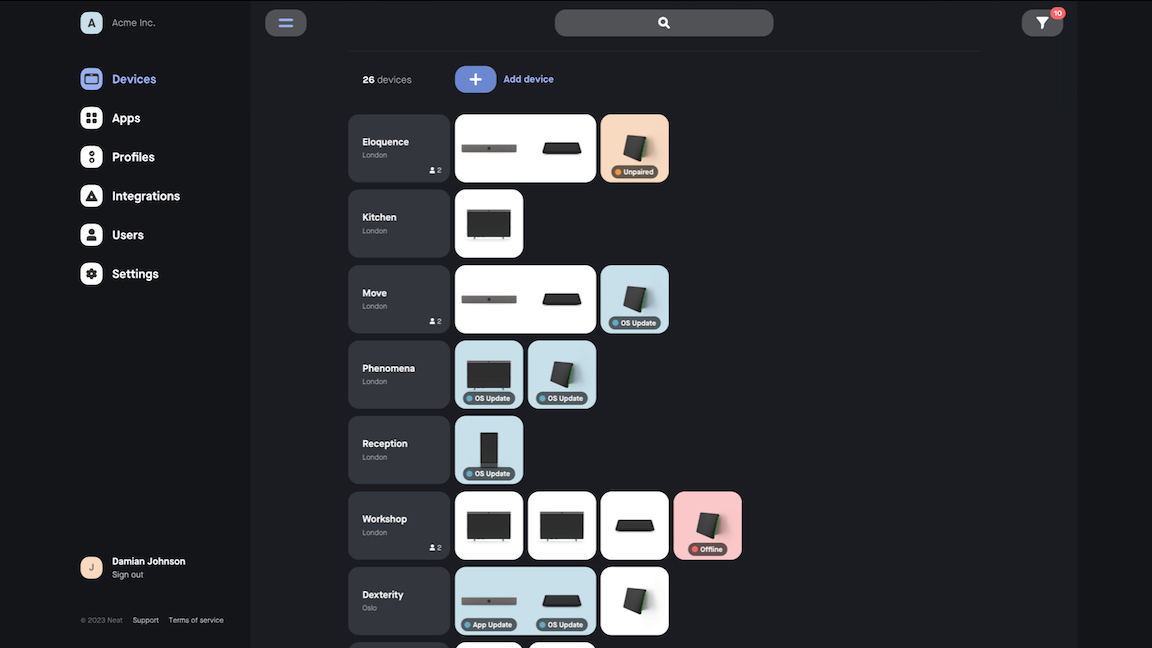
Neat Pulse reflects this broader industry movement. It provides centralized cloud-based management and monitoring for Neat devices, allowing organizations to remotely manage deployments, monitor device health, deploy updates, and gain visibility into meeting room environments.
In 2026, meeting rooms are increasingly treated as organizational infrastructure rather than isolated technology projects.
Scalability evaluation framework
| Factor | Why it matters |
| Remote management | Reduces operational overhead |
| Analytics and insights | Supports optimization |
| Standardized deployment | Improves consistency |
| Flexible room support | Adapts to changing needs |
Meeting equity is becoming the defining metric
One of the most important concepts shaping conferencing technology in 2026 is meeting equity.
Meeting equity refers to creating environments where remote participants can engage as naturally and effectively as those physically present in the room.
This has become increasingly important because hybrid work is now permanent infrastructure rather than a temporary accommodation. Organizations recognize that uneven meeting experiences reduce engagement, collaboration quality, and productivity.
Technologies such as intelligent framing, multi-camera systems, adaptive audio, and companion devices like Neat Center are specifically designed to improve hybrid meeting equity by ensuring everyone in the room remains visible and audible.
Traditional vs equitable hybrid meetings
| Element | Traditional setup | Meeting-equity-focused setup |
| Remote participant visibility | Limited | Balanced |
| Audio quality | Uneven | Adaptive |
| Engagement | Lower | Higher |
| Inclusion | Inconsistent | Improved |
Sustainability and operational efficiency are increasingly connected
Organizations are also placing greater emphasis on operational efficiency, sustainability, and room utilization.
Integrated conferencing systems can reduce hardware complexity, simplify room infrastructure, and improve energy efficiency compared with fragmented AV deployments.
Modern systems increasingly include environmental sensors and room analytics that help organizations monitor occupancy, air quality, and space utilization. This data helps companies optimize workplace environments while supporting broader sustainability goals.
The broader shift is toward intelligent workplace infrastructure where conferencing systems support both collaboration and operational insights.
How all these elements work together
The best conferencing systems are no longer collections of separate features. They are ecosystems where AI, audio, video, room systems, cloud management, interoperability, and workflow integration work together seamlessly.
Modern conferencing ecosystem model
| Layer | Role | Outcome |
| Audio | Enables communication | Clear collaboration |
| Video | Supports engagement | Better participation |
| AI | Automates optimization | Reduced friction |
| Interoperability | Supports flexibility | Easier collaboration |
| Cloud management | Enables scalability | Operational efficiency |
Organizations that succeed with hybrid work increasingly focus on designing complete collaboration systems rather than purchasing isolated hardware components.
Key takeaways
| Priority | Insight | Impact |
| High | Simplicity drives adoption | Better meeting experiences |
| High | AI is becoming foundational | Greater efficiency |
| High | Interoperability is essential | Flexible collaboration |
| Medium | Centralized management supports scalability | Operational consistency |
| Medium | Meeting equity improves engagement | Better hybrid collaboration |
Bringing it all together
Choosing the right video conferencing solution in 2026 is ultimately about choosing how your organization collaborates.
The most effective systems are the ones that reduce friction, improve meeting equity, integrate naturally into workflows, and scale consistently across locations. As hybrid work matures, conferencing systems are becoming the operating system of collaboration itself.
Organizations that invest in intelligent, integrated, and flexible systems will be better positioned to support employees, improve productivity, and create meeting experiences that feel natural rather than technical.
The future of video conferencing is not about adding more complexity to meeting rooms. It is about creating environments where technology disappears into the background and collaboration happens effortlessly.
How Neat fits in
Many of the trends shaping video conferencing in 2026—simplicity, AI-powered experiences, interoperability, centralized management, and meeting equity—are reflected in Neat’s approach to collaboration technology. Rather than relying on complex AV deployments with multiple disconnected components, Neat designs integrated devices such as Neat Bar Generation 2, Neat Bar Pro, Neat Board 32, and Neat Board Pro that combine hardware, software, and intelligent automation into a single collaboration experience.
Features such as Neat Symmetry help ensure remote participants can see everyone clearly, while Neat Center extends visibility and audio coverage in larger spaces to improve meeting equity.
Combined with Neat Pulse for centralized cloud management, organizations can deploy, monitor, and scale conferencing environments more efficiently while delivering the seamless, intuitive experiences employees increasingly expect from workplace technology.
Book a demo or explore our range of devices today.
Frequently asked questions
What is the most important factor when choosing a video conferencing solution?
Ease of use and meeting quality are typically the most important factors because they directly influence adoption, productivity, and overall collaboration outcomes.
What makes a modern video conferencing solution different from traditional systems?
Modern solutions combine hardware, software, AI, cloud management, room systems, and workflow integrations into a unified collaboration ecosystem rather than relying on separate components.
Why is interoperability important for businesses?
Most organizations use multiple collaboration platforms. A flexible conferencing solution allows employees to join meetings across different ecosystems without changing hardware or workflows.
How important is audio quality compared to video quality?
Audio quality is often the most critical factor in meeting effectiveness. If participants cannot hear clearly, collaboration suffers regardless of video quality.
What AI features should organizations look for in 2026?
Common AI capabilities include automatic framing, speaker tracking, noise suppression, real-time transcription, meeting summaries, and action-item extraction.
What is meeting equity?
Meeting equity is the ability for remote and in-room participants to engage equally in a meeting, regardless of location.
Why is centralized device management important?
Centralized management allows IT teams to monitor device health, deploy updates, troubleshoot remotely, and maintain consistency across multiple locations.
How can organizations improve adoption of video conferencing technology?
Choosing simple, intuitive systems with consistent user experiences, one-touch join functionality, and minimal training requirements typically leads to higher adoption rates.
What role does scalability play in solution selection?
As organizations grow, conferencing systems must support additional rooms, locations, and users without increasing operational complexity.
How do integrated conferencing systems improve ROI?
Integrated systems reduce support overhead, simplify deployment, improve reliability, increase utilization, and create better meeting experiences that drive long-term value.
Sources
Stacked AV – Meeting Room AV Trends for 2026
Cordless Consultants – Video Conferencing Strategy: A Strategic Guide for the 2026 Built Environment
No Jitter – What to Consider with Meeting Room Interoperability
TechRadar Pro – Flexibility Without Friction and the Multi-Platform Collaboration Challenge
AVer – Video Conferencing Trends
Worktech Academy – Workplace Innovations and Collaboration Technology Trends