

Why Neat’s Intelligent, Simple, Distributed AV Is the Next Evolution of the Codec
Tormod Ree, Dec 9, 2025
The future of meeting-room AV won’t come from remodelling classic centralized codec architecture. It will come from taking the next step—distributing compute, intelligence, and awareness across the room.
Every few weeks, someone asks us the same question:
“Why doesn’t Neat build a codec?”
It’s a fair question. Codecs have been the backbone of professional video systems for decades—iconic, trusted, and in many cases beloved. Many of us at Neat, including our Co-Founder and CTO, Ivar Johnsrud, spent years pushing the boundaries of codec design. Ivar was one of the hardware minds behind what many still regard as the pinnacle of codec engineering: the Tandberg C90, later the Cisco C90.
This device was a marvel of its time:
- 10,000+ components.
- Dedicated video and audio boards.
- Fifty-six processing cores.
- A fortress of proprietary connectors.
It solved hugely complex problems in an era before mobile computing, AI, software-defined AV, or modern networking. Traditional codecs weren’t just good—they were brilliant engineering for that era.
Why codecs existed and evolved the way they did
Manufacturers built these hardware-based systems on a clear, elegant principle: a single, powerful, centralized brain managing all compute, logic, and processing. Everything else—cameras, microphones, speakers, screens—connected as “peripherals” to that brain through proprietary cabling. It was exemplary architecture for the constraints of the time.
But as with any architecture, it carried natural limitations:
1. Fixed capacity: You selected a box based on room size. If the room configuration or size changed in any way, you couldn’t adjust the system.
2. Complex, proprietary installations: Custom connectors, pinouts, extenders, and cabling diagrams required expert installers.
3. Expensive components: High-end DSPs, FPGAs, and custom circuitry added cost.
4. Peripherals with limited intelligence: Cameras and mics acted as inputs, not collaborators.
5. Static, preset-driven experiences: Rooms needed careful programming; users had to adapt to the system. It couldn’t adapt to them.
The world changed, and codec evolution began
For the late 2000s and early 2010s, this was absolutely the best way to build video systems. The codec era pushed the industry forward in extraordinary ways. But the world has dramatically shifted gears. Since the C90 debuted in late 2008, four major technology evolutions have completely redefined what’s possible:
- Massive mobile compute: Modern chipsets deliver at least 10× the performance and 20-30× the efficiency.
- Modern software architecture: Monolithic applications gave way to distributed services and continuous updates.
- AI everywhere: Advanced computer vision, audio intelligence, beamforming, and contextual meeting awareness are now standard.
- Everything over IP: Ethernet and PoE replaced proprietary cabling.
These breakthroughs opened the door to a far better way to deliver AV experiences. Yet, as industries often do during major transitions, most vendors tried to preserve the past rather than redefine the future. They rebuilt the old architecture with newer parts. A more powerful, sleeker, and smarter box. But still… a box.
The result?
Horseless carriages.
Before cars, there were horse-drawn carriages. Then came the combustion engine and mass production—but instead of inventing the car, the first instinct was simply to remove the horse. People didn’t yet imagine the automobile.
Modern codecs still carry the original assumptions: centralized compute, fixed capacity, expensive hardware, and static experiences. At Neat, we’ve chosen to embrace the next stage of codec evolution—not a bigger box, but a distributed codec model. In other words, we chose to create the car, not upgrade the carriage.
The Neat approach: distributed, intelligent, modular
What if every device in the room carried its own intelligence?
What if the compute was not centralized, but coordinated across the room?
What if rooms scaled like networks do—fluidly and on-demand?
What if the system adapted to the meeting, not the other way around?
This is the evolution of the codec. This is Neat’s modular architecture.
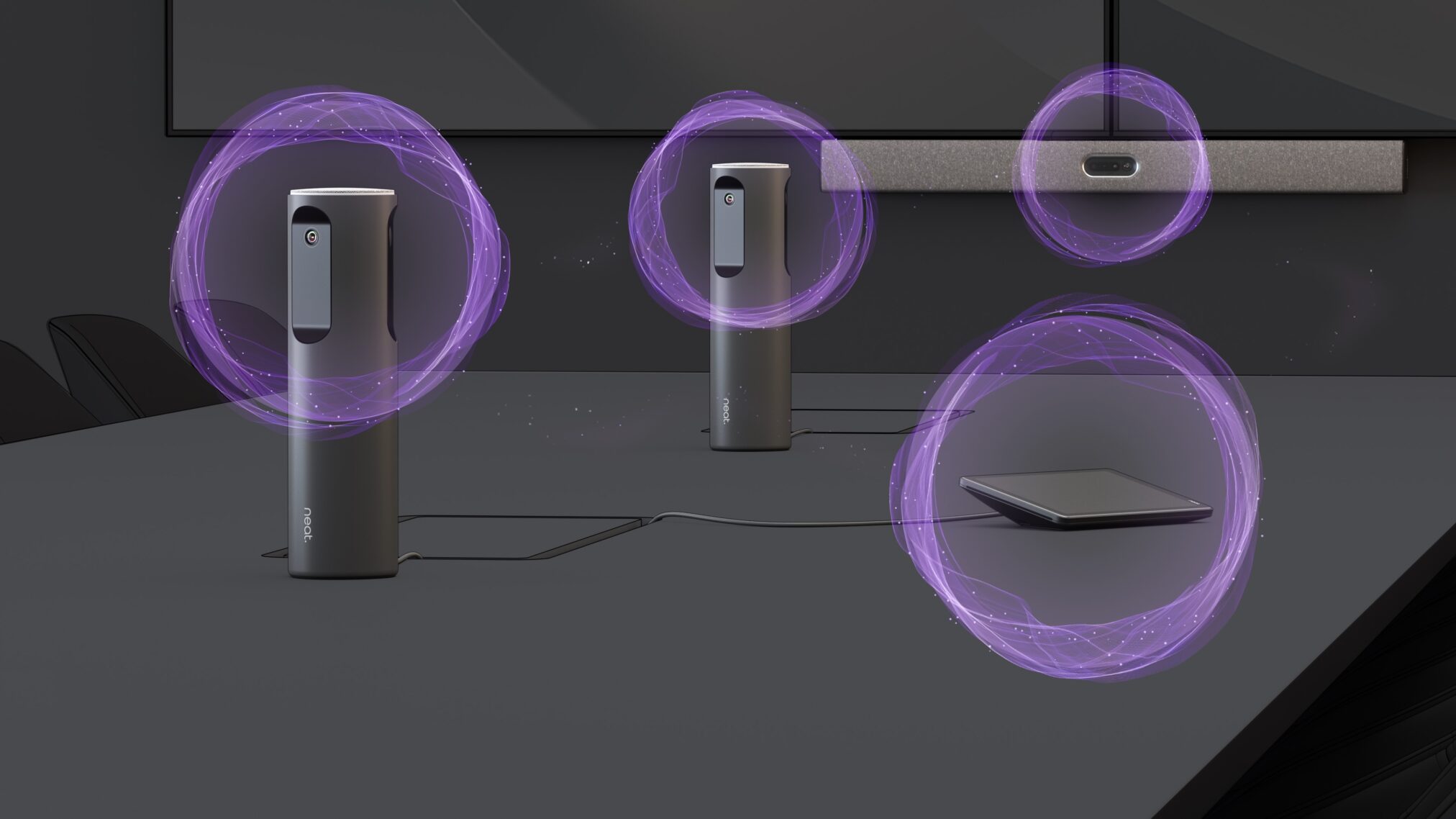
1. Distributed intelligence: There is no central compute box. Every device—from our Neat Bar and Neat Board devices to our Neat Center and Neat Pad companion devices, and future components—brings its own compute (processing, AI, and sensing) to the overall system.
2. Everything over the network: No proprietary cabling, no wiring diagrams that require deep certification. Just PoE and Ethernet.
3. Infinite scalability: Need more coverage? Add more devices. Need less? Remove one. Rooms grow, shrink, split, or repurpose—without replacing core hardware.
4. Mix-and-Match Flexibility: Rigid room types or monolithic systems don’t restrict you. You should be able to:
- Add cameras for new viewing angles
- Add microphones to extend pickup
- Add Neat Centers for distributed framing
- Add repeater screens
- Add or remove main devices
And the system simply figures it out.
5. Context-aware experiences: Instead of presets and programming, the system “reads the room”—contextually adjusting to the meeting, its participants, and their interactions.
This is how we’re building the future of large meeting rooms
Today, our multi-device architecture already supports:
- A main device
- Two Neat Centers
- A Neat Pad meeting controller with integrated mics
- Additional audio/video extensions
And this is only the beginning. In the coming evolution, you’ll see more intelligent AV-over-IP-enabled devices and peripherals that will make you reimagine how to build a conference room. Rooms with 18–20 participants—like the ones we’re designing for some of our corporate customers—are already validating this direction.
Are we finished? Not in the slightest. Large rooms require more devices and deeper coverage, and we’re confident we’ll meet those needs. Traditional codec systems scaled according to the design principles of their era. Our architecture simply gives customers a more flexible, modular way to expand as requirements change.
So, why don’t we build a codec?
We do—just not in the old centralized box form. We’re not abandoning the codec; we’re evolving it. Because building a codec the traditional way is a bit like building a horseless carriage—you can absolutely do it, and it will work. But it doesn’t fully harness the technological progress of the last 15 years. Our approach captures the essence of the codec and reimagines it as simpler, smarter, more flexible, and far more scalable.
A truly modern architecture for truly modern meeting spaces.
Experience our pioneering devices in action during one of our live product tours or book a one-on-one demo with a Neat specialist for a personalized deep dive.