

Why Touchless Meeting Rooms Are Here to Stay: 7 Benefits for Hybrid Work in 2026
Hayley Spooner, Aug 3, 2026
Key takeaways
- Touchless meeting rooms reduce friction by automating common meeting tasks and simplifying collaboration.
- AI-powered cameras, microphones, and sensors help create more inclusive hybrid meetings.
- Wireless content sharing and automatic room activation make meetings easier to start and manage.
- Touchless technology improves accessibility while creating a better experience for every participant.
- Intelligent meeting rooms reduce the need for manual controls, helping employees focus on collaboration instead of technology.
- Organizations benefit from easier IT management, improved room utilization, and more consistent meeting experiences.
Introduction
The conversation around touchless meeting rooms has changed dramatically over the past few years.
While touchless technology initially gained attention for reducing shared contact points, today’s organizations are investing in intelligent meeting spaces for a very different reason: they create better meeting experiences.
Employees expect meeting rooms to work as naturally as the technology they use every day. They don’t want to waste time searching for remote controls, adjusting cameras, troubleshooting microphones, or figuring out how to share content. Instead, they expect meeting rooms to recognize when people arrive, optimize audio and video automatically, and make collaboration feel effortless.
As hybrid work continues to evolve, organizations are increasingly looking for meeting spaces that remove unnecessary friction rather than add to it.
This guide explains what touchless meeting rooms are, why they’re becoming the new standard for modern workplaces, and the technologies helping organizations create simpler, smarter collaboration experiences in 2026.
What is a touchless meeting room?
A touchless meeting room uses intelligent technology to automate common meeting tasks, reducing the need for manual interaction while making collaboration faster and easier.
Rather than relying on physical buttons, remote controls, or complicated room systems, touchless meeting rooms use a combination of intelligent hardware, software, and touchless interfaces to simplify the meeting experience.
Common touchless capabilities include:
- Automatic room activation.
- Occupancy detection.
- AI-powered camera framing.
- Intelligent microphone arrays.
- Wireless content sharing.
- Voice-aware audio processing.
- Environmental sensing.
- Automatic software updates.
The objective isn’t to remove every physical interaction.
Instead, it’s to eliminate unnecessary steps that interrupt collaboration.
The result is a meeting room that feels intuitive, allowing participants to focus on the conversation instead of the technology.
Why touchless meeting rooms matter in 2026
Modern meeting rooms should help meetings happen—not require users to manage technology before collaboration can begin.
As organizations continue to support hybrid work, employees move between home offices, corporate offices, and shared workspaces throughout the week.
That flexibility creates new expectations.
People want meeting rooms that work immediately, regardless of where they’re joining from or which collaboration platform they’re using.
Touchless meeting rooms support those expectations in several important ways.
They reduce meeting friction
Small interruptions quickly add up.
Searching for remote controls, adjusting cameras, connecting cables, or troubleshooting room technology wastes valuable meeting time.
Touchless meeting rooms automate many of these routine tasks, allowing meetings to begin more quickly and reducing frustration for users.
They create a more consistent experience
Employees shouldn’t have to relearn how to use every meeting room they enter.
Intelligent meeting spaces create consistent experiences across offices by using familiar interfaces and automating repetitive tasks wherever possible.
They support accessibility
Reducing dependence on physical controls can make meeting spaces easier to use for people with a wide range of accessibility needs.
Automatic room activation, voice-aware technology, intelligent cameras, and wireless collaboration tools help create more inclusive meeting experiences for every participant.
They simplify IT management
Modern meeting rooms are increasingly managed remotely.
Automatic software updates, cloud-based monitoring, and centralized device management reduce the amount of manual maintenance required while helping IT teams deliver more reliable meeting experiences across multiple locations.
7 reasons touchless meeting rooms are here to stay
Technology should disappear into the background, allowing people to focus entirely on collaborating with one another.
These are some of the biggest reasons organizations continue investing in touchless meeting experiences.
1. Meetings start faster
One of the biggest frustrations in any meeting is waiting for the technology to work.
Touchless meeting rooms help eliminate many of the delays that traditionally occur before conversations even begin.
Instead of asking participants to:
- Turn on equipment.
- Adjust cameras.
- Connect cables.
- Launch applications.
- Configure microphones.
Modern meeting spaces can automatically detect occupancy, wake devices, prepare cameras, and make the room ready for collaboration.
Those small time savings quickly add up across hundreds or thousands of meetings each year.
2. Hybrid meetings feel more natural
One of the biggest challenges in hybrid work is creating an experience where remote participants feel just as involved as colleagues sitting in the room.
Touchless technology helps reduce that gap.
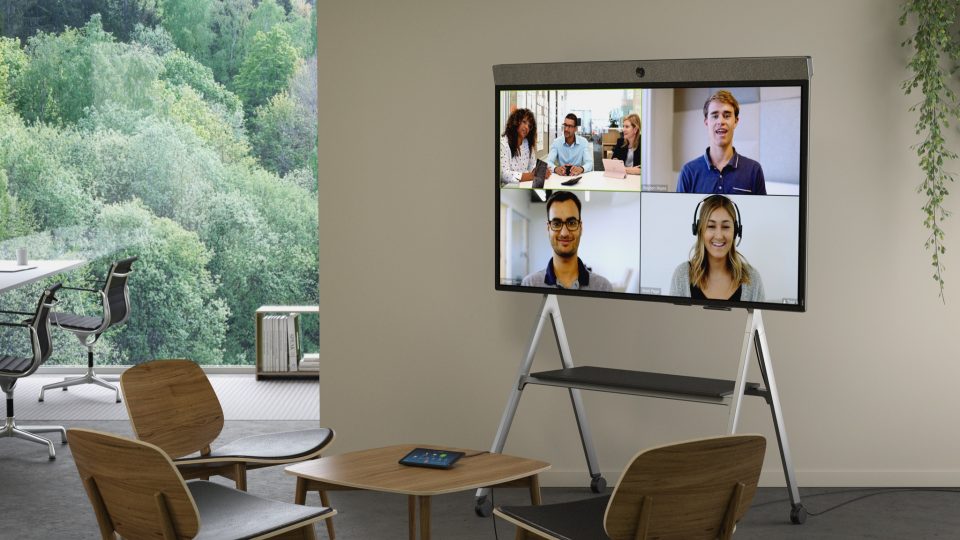
AI-powered cameras automatically frame participants as conversations develop, while intelligent microphones capture voices more clearly across the room.
Rather than requiring someone to manually adjust equipment throughout the meeting, these technologies work continuously in the background.
The result is a more natural experience where participants can focus on collaboration instead of managing technology.
3. Meeting rooms become easier to use
The best meeting rooms require almost no training.
Employees should be able to walk into a room and immediately understand how to start collaborating.
Touchless meeting rooms reduce complexity by automating many of the steps that previously required multiple devices, remote controls, or complicated instructions. Applying good human factors principles helps organizations design meeting rooms that feel intuitive and reduce unnecessary cognitive effort for users.
This creates a simpler experience for occasional users while reducing the number of support requests IT teams receive.
As organizations expand their meeting room deployments, ease of use becomes just as important as advanced features.
4. Accessibility improves for everyone
Touchless technology doesn’t just improve convenience—it also helps create more inclusive workplaces.
Automatic room activation, wireless content sharing, intelligent camera tracking, and voice-aware technologies reduce reliance on physical controls that may be difficult for some users to access.
More importantly, AI-powered collaboration technologies help ensure everyone can participate fully in meetings, regardless of whether they’re joining from the conference room or remotely.
When technology adapts to people instead of expecting people to adapt to technology, meetings become more accessible, engaging, and equitable for everyone.
5. Wireless collaboration is becoming the standard
Modern employees expect to walk into a meeting room and start collaborating immediately.
That expectation has accelerated the adoption of wireless content sharing, allowing participants to present, brainstorm, and collaborate without searching for adapters or connecting cables.
Wireless collaboration offers several benefits:
- Faster meeting starts.
- Fewer technical interruptions.
- Greater flexibility for hybrid teams.
- Easier collaboration for guests.
- Cleaner, less cluttered meeting spaces.
As organizations adopt more flexible workspaces, wireless collaboration has become an essential part of creating frictionless meeting experiences.
6. AI is making meeting rooms smarter
Artificial intelligence is transforming meeting rooms from static spaces into intelligent collaboration environments.
Rather than requiring participants to adjust settings throughout a meeting, AI continuously optimizes the experience behind the scenes.
Modern AI-powered meeting rooms can:
- Automatically frame speakers.
- Adjust camera views as conversations change.
- Optimize microphone performance.
- Reduce background noise.
- Improve speech clarity.
- Adapt to changing room conditions.
These capabilities are part of a broader shift toward more natural human-machine interaction, where technology responds intelligently to people instead of requiring people to constantly control technology.
7. IT teams can manage meeting rooms more efficiently
Touchless meeting rooms don’t just improve the employee experience—they also simplify device management.
Instead of maintaining every room individually, IT teams can remotely monitor devices, deploy software updates, diagnose issues, and manage meeting spaces from a central location.
This approach helps organizations:
- Reduce downtime.
- Improve reliability.
- Standardize meeting experiences.
- Simplify software updates.
- Scale collaboration technology across multiple offices.
For organizations with dozens or hundreds of meeting rooms, centralized management significantly reduces administrative effort while improving the overall user experience.
Touchless meeting room features
The most effective touchless meeting rooms combine multiple intelligent technologies that work together to create a seamless experience.
| Feature | Benefit |
| Automatic room activation | Meetings are ready when participants arrive |
| Wireless content sharing | Faster collaboration with fewer cables |
| AI-powered camera framing | Better visibility for remote participants |
| Intelligent microphone arrays | Clearer conversations across the room |
| Occupancy sensing | Better room utilization and workplace insights |
| Centralized device management | Easier monitoring and maintenance for IT teams |
Common mistakes when designing touchless meeting rooms
Simply adding new technology doesn’t automatically create a better meeting experience.
Avoid these common mistakes.
Overcomplicating the room experience
Meeting rooms should feel intuitive.
If users need extensive training or lengthy instructions, the technology is creating friction instead of removing it.
Focusing only on people in the room
Hybrid meetings should provide an excellent experience for remote participants as well as those sitting around the conference table.
Ignoring accessibility
Touchless technology should make meeting rooms easier for everyone to use, regardless of physical ability or technical confidence.
Relying on outdated meeting room technology
Modern collaboration has evolved significantly.
Older room systems often require multiple remotes, manual configuration, or complicated setup processes that slow meetings down.
Forgetting about long-term management
Meeting rooms need ongoing software updates, monitoring, and maintenance.
Choosing solutions that support centralized management helps organizations maintain consistent meeting experiences over time.
Trends shaping touchless meeting rooms in 2026
Touchless meeting rooms continue to evolve alongside advances in AI and workplace technology.
Several trends are shaping the next generation of collaboration spaces.
Intelligent room awareness
Meeting rooms are becoming increasingly aware of occupancy, participant location, and environmental conditions, allowing technology to adapt automatically throughout meetings.
AI-powered collaboration
Artificial intelligence continues to improve camera framing, microphone performance, speaker tracking, and meeting quality without requiring manual adjustments.
Flexible workplaces
Organizations are designing meeting spaces that support a mix of in-office employees, hybrid workers, and remote participants with consistent collaboration experiences.
Workplace insights
Environmental and occupancy data are helping organizations better understand how meeting rooms are being used, supporting more informed workplace planning and resource allocation.
Simplicity by design
The best meeting rooms increasingly require little or no user interaction, allowing technology to fade into the background so people can focus on the conversation.
Where Neat fits in
Creating a truly touchless meeting room requires technology that works intelligently behind the scenes rather than demanding constant user interaction.
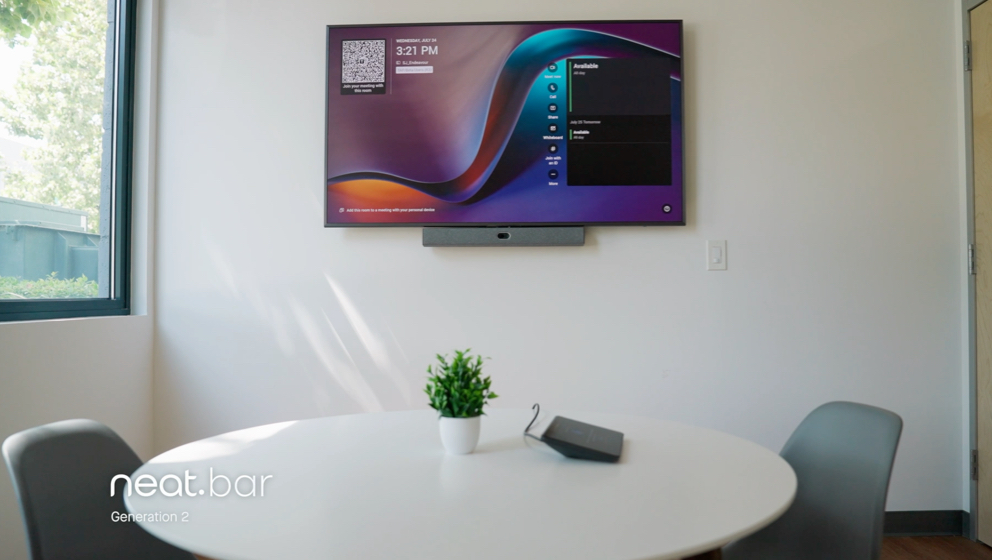
For medium and large meeting spaces, Neat Bar Generation 2 combines intelligent cameras, adaptive microphone arrays, premium speakers, and AI-powered processing to deliver exceptional audio and video with minimal user intervention. Features such as Neat Symmetry automatically frame participants, creating more engaging and equitable hybrid meetings.
To extend visibility beyond the front of the room, Neat Center works alongside compatible Neat devices to capture conversations from every angle, helping remote participants feel more connected to discussions happening throughout the room.
For interactive collaboration, Neat Board Pro combines video conferencing, wireless content sharing, digital whiteboarding, and an expansive touchscreen into a single device. It’s designed for organizations that want to simplify collaboration without relying on multiple pieces of equipment.
Supporting every meeting are Neat Experiences, which continuously optimize audio, video, participant framing, and meeting performance using proprietary AI-powered technologies. These intelligent capabilities operate automatically, reducing the need for manual adjustments during meetings.
Organizations can also benefit from Neat Sense, which provides valuable occupancy and environmental insights, including room usage, air quality, temperature, humidity, and CO₂ levels. These insights help workplace teams optimize meeting spaces while supporting healthier office environments.
For IT administrators, Neat Pulse provides cloud-based device management, allowing teams to remotely monitor meeting rooms, deploy software updates, and maintain consistent collaboration experiences across multiple locations.
Finally, Neat Open gives organizations the flexibility to choose the collaboration platforms that best fit their business, ensuring meeting rooms can evolve alongside changing workplace requirements.
Together, these solutions help organizations create meeting spaces that are easier to use, simpler to manage, and better prepared for the future of hybrid work.
Perhaps it’s time to book a demo and experience them for yourself.
Frequently asked questions
What is a touchless meeting room?
A touchless meeting room uses intelligent technology to automate tasks such as room activation, camera framing, audio optimization, and wireless content sharing, reducing the need for manual interaction.
Why are touchless meeting rooms important?
They simplify meetings, reduce technical delays, improve accessibility, and create better collaboration experiences for both in-room and remote participants.
How do touchless meeting rooms work?
They combine technologies such as occupancy sensors, AI-powered cameras, intelligent microphones, wireless content sharing, and cloud-based management to automate common meeting tasks.
Do touchless meeting rooms improve productivity?
Yes. By reducing setup time and minimizing technical interruptions, touchless meeting rooms help meetings start faster and allow participants to focus on collaboration instead of technology.
What technologies make a meeting room touchless?
Common technologies include automatic room activation, AI camera framing, intelligent microphone arrays, wireless content sharing, occupancy sensing, and centralized device management.
Are touchless meeting rooms more accessible?
Yes. Reducing reliance on physical controls and automating routine tasks helps create more inclusive meeting experiences for employees with different accessibility needs.
Can AI improve meeting room experiences?
Absolutely. AI can automatically optimize audio, adjust camera framing, reduce background noise, and improve the experience for both in-room and remote participants.
What is the future of touchless meeting rooms?
Future meeting rooms will become increasingly intelligent, using AI and environmental awareness to automatically adapt to participants and create seamless collaboration experiences.
Sources
- Touchless Intraoperative Image Access System Based on Vision-Based Hand Tracking | arXiv | https://arxiv.org/abs/2604.24235
- Don’t Touch Me! A Comparison of Usability on Touch and Non-Touch Inputs | arXiv | https://arxiv.org/abs/2107.05408
- Distributed Gesture Controlled Systems for Human-Machine Interface | arXiv | https://arxiv.org/abs/2304.06152
- Human Factors and Ergonomics | National Institute for Occupational Safety and Health (NIOSH) | https://www.cdc.gov/niosh/
- Acoustics and Sound | Acoustical Society of America (ASA) | https://acousticalsociety.org/