

8 Teleconference System Types for Hybrid Offices (A 2026 Guide)
Hayley Spooner, Jun 4, 2026
Key takeaways
- Teleconference systems have evolved beyond traditional conference room setups into intelligent collaboration ecosystems designed for hybrid work.
- The eight primary teleconference system categories in 2026 are personal conferencing, huddle rooms, medium meeting rooms, large conference rooms, BYOM systems, conferencing powered by artificial intelligence (AI), immersive collaboration systems, and cloud-managed ecosystems.
- Hybrid work has increased demand for flexible, platform-agnostic conferencing environments that support employees across offices, homes, and shared workspaces.
- AI-powered capabilities such as automatic framing, intelligent audio, transcription, and meeting summaries are becoming standard features rather than premium add-ons.
- Meeting equity has become a major priority, driving adoption of immersive and multi-camera systems that help remote participants engage more naturally.
- Organizations are increasingly prioritizing simplicity, interoperability, cloud management, and scalability when selecting conferencing solutions.
- The future of teleconferencing is focused on creating seamless collaboration experiences where technology fades into the background and teams can work effectively regardless of location.
Teleconference systems have changed dramatically over the last few years. What once referred primarily to conference room speakerphones and static video setups has evolved into a much broader ecosystem of intelligent collaboration environments designed for hybrid work.
In 2026, organizations are no longer choosing between just a handful of teleconferencing setups. Hybrid work, AI-powered collaboration, cloud management, interoperability, and flexible office design have expanded the number of meaningful teleconference system categories used in modern workplaces.
This shift matters because organizations now rely on different types of meeting environments for different styles of collaboration. A small huddle room used for quick project discussions has very different requirements from a large hybrid boardroom or a cloud-managed enterprise meeting ecosystem spanning multiple offices.
The result is that the traditional “6 types” framework no longer fully reflects how modern organizations collaborate. In 2026, there are now eight core teleconference system categories shaping hybrid offices.
Quick answer: What are the main types of teleconference systems in 2026?
The eight primary teleconference system types used in modern hybrid workplaces are:
- Personal and desktop conferencing systems
- Huddle room conferencing systems
- Medium meeting room systems
- Large conference room systems
- BYOM (Bring Your Own Meeting) systems
- AI-powered smart conferencing systems
- Immersive and multi-camera collaboration systems
- Cloud-managed conferencing ecosystems
These categories reflect the major workplace and technology trends shaping collaboration in 2026, including hybrid work, AI automation, interoperability, meeting equity, and intelligent workplace infrastructure.
Why teleconference systems have evolved
The biggest reason teleconference systems have expanded is that hybrid work fundamentally changed how offices operate.
Earlier conferencing systems were designed around fixed conference rooms and single-platform workflows. Meetings usually involved participants who were either all remote or all physically together in the room.
That model no longer reflects reality.
In 2026, meetings happen across home offices, collaboration hubs, huddle rooms, shared spaces, executive boardrooms, and mobile devices simultaneously. Employees also expect flexibility to join meetings using multiple platforms such as Microsoft Teams, Zoom, and Google Meet without changing room configurations.
At the same time, AI has become deeply integrated into conferencing environments. Features such as automatic framing, intelligent audio processing, transcription, meeting summaries, and adaptive room controls are increasingly considered baseline functionality rather than premium add-ons.
This combination of hybrid work and intelligent collaboration technology has expanded both the complexity and the capabilities of teleconference systems.
1. Personal and desktop conferencing systems
Personal conferencing systems remain the foundation of hybrid work because individual employees continue to work across multiple environments, including home offices, flexible desks, coworking spaces, and while traveling.
In 2026, these systems are much more advanced than simple webcams and headsets. Employees increasingly expect AI-powered cameras, adaptive microphones, intelligent lighting correction, and integrated collaboration tools that work seamlessly across platforms.
The rise of asynchronous communication has also increased the importance of personal conferencing setups. Employees are not only joining live meetings but also recording updates, sharing presentations, and collaborating across time zones. This means personal systems must support a broader range of communication workflows.
Companies are also increasingly prioritizing consistency between personal workspaces and office meeting environments. This ensures employees can move between remote and in-office work without friction or changes in user experience.
Key characteristics of personal conferencing systems
| Feature | Purpose |
| AI-powered cameras | Better framing and visibility |
| Noise suppression | Clearer communication |
| Intelligent microphones | Improved voice pickup |
| Platform integration | Seamless workflows |
| Portable setups | Flexible working environments |
2. Huddle room conferencing systems
Huddle rooms have become some of the most heavily used collaboration spaces in hybrid offices.
These small rooms, typically supporting two to six participants, are designed for fast collaboration, ad hoc discussions, and hybrid calls. Many organizations now deploy significantly more huddle rooms than traditional boardrooms because hybrid work favors smaller, more agile collaboration sessions.
Modern huddle room systems focus heavily on simplicity and speed. Employees expect to enter the room, start a meeting instantly, and share content wirelessly without technical setup.
Neat systems such as Neat Bar are designed specifically around this type of environment, combining cameras, microphones, and speakers into integrated systems that minimize friction. Neat devices also include AI-powered features such as auto-framing and intelligent audio processing that continuously adapt to participants and room conditions.
The broader industry trend is clear: organizations increasingly prioritize systems that “just work” because meeting delays and technical friction directly reduce productivity.
Huddle room technology priorities
| Capability | Why it matters |
| One-touch join | Faster meetings |
| Wide-angle camera | Full-room visibility |
| Adaptive audio | Clear conversations |
| Wireless sharing | Flexible collaboration |
| Compact design | Small-space optimization |
3. Medium meeting room systems
Medium meeting rooms remain the backbone of everyday collaboration in many hybrid offices.
These rooms are typically used for team meetings, project collaboration, and customer discussions involving six to twelve participants. In 2026, organizations increasingly prioritize integrated room systems over traditional AV setups because simplicity has become more important than feature complexity.
This shift reflects a broader industry realization: if meeting room technology feels difficult or unreliable, employees avoid using it.
Modern medium-room systems now rely heavily on AI-powered cameras, adaptive audio, and integrated conferencing platforms to create more natural hybrid experiences.
Solutions such as the Neat Bar Pro are designed specifically to support medium-sized meeting spaces while maintaining simple deployment and consistent user experience. Neat’s portfolio is also intentionally designed to scale across different room sizes so organizations can create standardized experiences throughout offices without adding complexity.
Medium-room conferencing priorities
| Priority | Impact |
| Integrated hardware | Reduced complexity |
| AI framing | Better engagement |
| Adaptive audio | Improved clarity |
| Platform flexibility | Easier collaboration |
| Consistent user-experience (UX) | Higher adoption |
4. Large conference room systems
Large conference room systems continue to play an important role for executive meetings, boardrooms, company-wide presentations, and customer-facing collaboration.
However, the expectations for these rooms have changed significantly.
In earlier conferencing environments, a single static camera and basic speakerphone were often considered sufficient. In 2026, large-room systems increasingly focus on meeting equity and immersive collaboration. Organizations now use intelligent camera systems, distributed microphones, adaptive audio, and multiple displays to ensure remote participants feel equally included in the conversation.
This shift is particularly important because hybrid work is now permanent infrastructure rather than a temporary adjustment.
Neat Center reflects this evolution toward more immersive and equitable hybrid meetings. Designed as a companion device, it provides 360-degree visuals and omnidirectional audio pickup so remote participants can clearly see and hear everyone in the room, even when conversations move away from the front display.
Large-room conferencing priorities
| Priority | Impact |
| Multi-camera systems | Better visibility |
| Intelligent framing | Improved engagement |
| Distributed microphones | Clearer communication |
| AI speaker tracking | More natural meetings |
| Large-display support | Enhanced collaboration |
5. BYOM (Bring Your Own Meeting) systems
One of the biggest changes in conferencing technology is the rapid growth of Bring Your Own Meeting (BYOM) workflows.
A few years ago, most meeting rooms were tied to a single conferencing platform. In 2026, that approach is increasingly viewed as restrictive because organizations now collaborate across multiple ecosystems. Employees may use Microsoft Teams internally, Zoom with customers, and Google Meet with partners.
BYOM systems allow employees to launch meetings directly from their own devices while still using the room’s cameras, microphones, and displays.
This approach is especially popular in smaller and medium-sized rooms because it combines platform flexibility with simpler room infrastructure.
The rise of BYOM reflects a larger trend toward platform-agnostic collaboration environments. Organizations increasingly want systems that support flexibility without adding operational complexity.
BYOM vs traditional room systems
| Feature | Traditional room | BYOM system |
| Platform flexibility | Limited | High |
| User control | Restricted | Flexible |
| Collaboration style | Fixed | Dynamic |
| Long-term flexibility | Lower | Higher |
6. AI-powered smart conferencing systems
Artificial intelligence has become one of the defining characteristics of conferencing systems in 2026.
AI is no longer treated as a premium enhancement. It is now becoming foundational infrastructure for collaboration systems. Modern teleconference environments increasingly support automatic framing, intelligent speaker tracking, real-time transcription, meeting summaries, workflow automation, and adaptive room controls.
These systems fundamentally change how meetings operate because they reduce cognitive load and eliminate many of the manual tasks previously associated with conferencing.
Neat’s AI-powered conferencing architecture reflects this broader trend toward systems that adapt automatically to room conditions and participant behavior rather than requiring constant user adjustment. Technologies such as Neat Symmetry automatically frame and present participants equally on-screen, helping improve meeting equity in hybrid environments.
AI capabilities in teleconference systems
| AI capability | Business benefit |
| Automatic framing | Better engagement |
| Intelligent audio | Clearer conversations |
| Real-time transcription | Accessibility |
| Meeting summaries | Reduced admin work |
| Workflow automation | Faster follow-up |
7. Immersive and multi-camera collaboration systems
Hybrid collaboration increasingly relies on immersive meeting experiences that move beyond static room views.
Multi-camera systems, panoramic room perspectives, intelligent switching, and dynamic speaker tracking are becoming increasingly common in larger meeting environments.
The goal is to make remote participants feel actively included in the room rather than simply observing from a distance.
This category is growing quickly because organizations increasingly recognize that meeting quality directly affects engagement, collaboration effectiveness, and productivity. Immersive conferencing systems are also becoming more important for webinars, executive broadcasts, training sessions, and large hybrid events.
Neat Center is a good example of this broader trend. With three cameras, a 360-degree field of view, and a 16-microphone array, it extends the meeting experience deeper into the room and helps remote participants follow natural conversations more effectively.
Immersive conferencing features
| Feature | Benefit |
| Multi-camera tracking | Better visibility |
| Panoramic views | Increased immersion |
| Intelligent switching | Natural meeting flow |
| Spatial audio | Better engagement |
| Dynamic layouts | Improved meeting equity |
8. Cloud-managed conferencing ecosystems
One of the most important developments in 2026 is the shift from isolated conferencing rooms to cloud-managed conferencing ecosystems.
Organizations now increasingly manage conferencing environments centrally through cloud platforms that provide remote monitoring, device management, analytics, software updates, and room usage insights.
This reflects a much broader industry transition where meeting rooms are treated as connected workplace infrastructure rather than standalone technology projects.
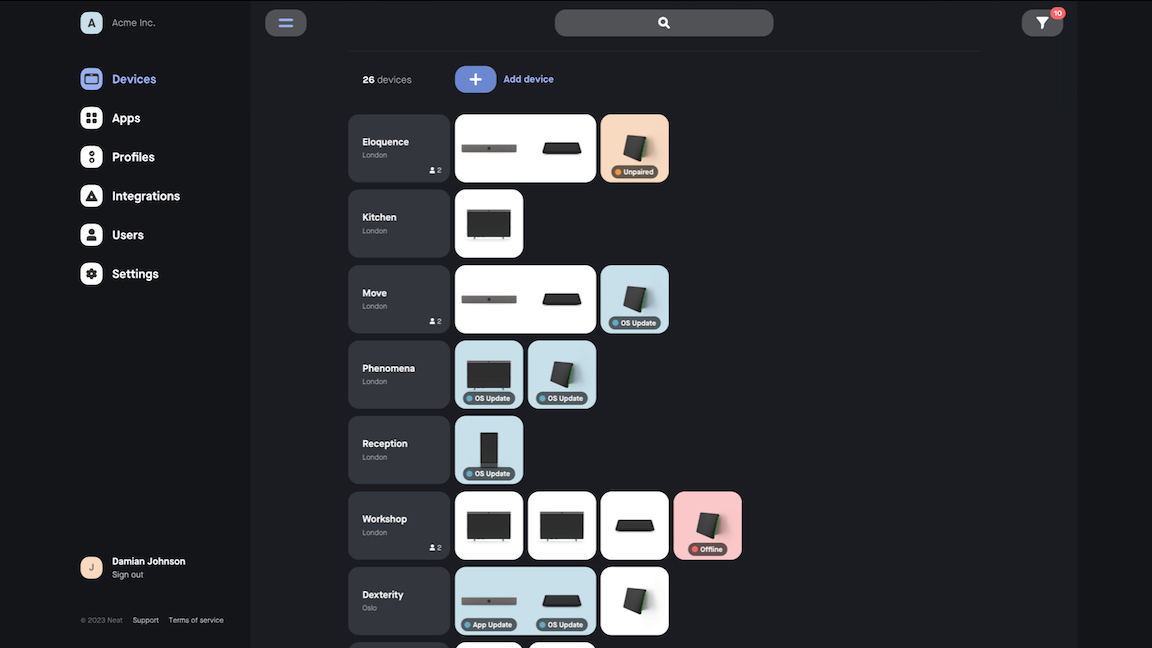
Neat Pulse reflects this movement toward centralized cloud-based management by allowing organizations to monitor device health, deploy updates, manage configurations, monitor environmental data, and remotely control devices across multiple locations.
The latest Neat Pulse updates also increasingly focus on automation, Application Programming Interfaces (APIs), and real-time visibility for enterprise IT teams managing conferencing environments at scale.
Cloud-managed conferencing capabilities
| Capability | Outcome |
| Remote monitoring | Reduced downtime |
| Centralized updates | Consistent performance |
| Analytics | Better optimization |
| Device management | Easier scalability |
| Environmental insights | Smarter workplaces |
How organizations are choosing conferencing systems in 2026
Organizations are increasingly moving away from one-size-fits-all conferencing strategies.
Instead, companies now design collaboration environments around actual workplace behavior. Small huddle spaces, flexible meeting rooms, immersive collaboration areas, and executive boardrooms all support different workflows and therefore require different conferencing systems.
At the same time, the most important purchasing criteria have shifted significantly. Simplicity, interoperability, AI integration, and meeting equity are now often considered more important than raw feature count.
Organizations are also increasingly prioritizing systems that can scale consistently across offices while remaining simple for employees and manageable for IT teams.
The most important conferencing priorities in 2026
| Priority | Why it matters |
| Simplicity | Improves adoption |
| Interoperability | Supports flexibility |
| AI integration | Reduces friction |
| Meeting equity | Improves hybrid collaboration |
| Cloud management | Simplifies scaling |
The future of teleconference systems
The future direction of teleconference systems is becoming increasingly clear. Systems are becoming more intelligent, more integrated, and more adaptive.
Hybrid work is no longer treated as temporary. Organizations now design offices, workflows, and meeting environments around distributed collaboration as a long-term operating model.
This means future conferencing systems will likely focus even more heavily on:
- AI-powered collaboration
- Platform-agnostic flexibility
- Intelligent workplace analytics
- Immersive meeting experiences
- Sustainability and operational efficiency
What matters most is no longer simply connecting people to meetings. It is creating collaboration environments where technology disappears into the background and meetings feel natural regardless of where participants are located.
Where Neat fits in
The evolution of teleconference systems reflects a broader shift in how organizations collaborate. Rather than deploying isolated conferencing tools for individual rooms, businesses are increasingly building connected collaboration ecosystems that support multiple room types, work styles, and meeting formats across the workplace.
This is where Neat aligns with many of the trends shaping modern teleconferencing. Across personal workspaces, huddle rooms, medium-sized meeting rooms, large conference spaces, immersive collaboration environments, and centrally managed deployments, organizations are looking for systems that combine simplicity, interoperability, AI-powered capabilities, and consistent user experiences.
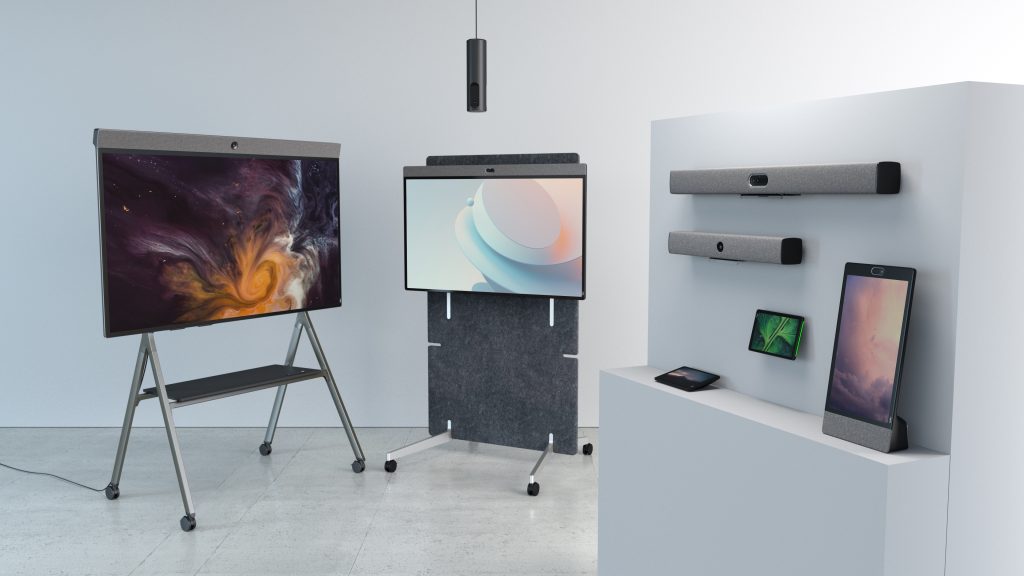
Neat’s portfolio is designed to support these evolving requirements. Solutions such as Neat Bar, Neat Board 50, Neat Bar Pro, and Neat Center address different teleconference system categories while maintaining a unified experience across spaces. Features including Neat Symmetry, intelligent audio processing, adaptive framing, and immersive room perspectives help support meeting equity and more natural hybrid collaboration.
At the organizational level, cloud management is becoming just as important as room technology itself. Neat Pulse reflects the industry’s move toward cloud-managed conferencing ecosystems, giving IT teams centralized visibility, device management, analytics, and operational control across multiple locations.
As teleconference systems continue to evolve, organizations are increasingly prioritizing platforms that can scale consistently while remaining simple for employees and manageable for IT teams. By combining AI-powered collaboration, flexible room solutions, immersive meeting experiences, and centralized management, Neat supports the key capabilities that modern hybrid workplaces increasingly depend on.
Ultimately, the future of teleconferencing is not simply about connecting people to meetings. It is about creating intelligent, inclusive, and friction-free collaboration environments that enable teams to communicate naturally, wherever they work.
Discover Neat’s pioneering devices or book a demo and experience them for yourself.
Frequently asked questions
What is the fastest-growing teleconference category?
BYOM systems and AI-powered conferencing systems are among the fastest-growing categories in hybrid offices.
Why are cloud-managed conferencing systems important?
They improve scalability, reduce IT overhead, and provide analytics that help organizations optimize meeting environments.
How does AI improve teleconference systems?
AI improves framing, audio quality, transcription, accessibility, meeting summaries, and workflow automation.
Sources
- Boom Collaboration — Top conferencing trends for 2026: https://boom.co/blog/the-top-5-conferencing-trends-for-2026
- AVer — Video conferencing trends: https://www.aver.com/AVerExpert/Video-Conferencing-Trends
- TechRadar — Flexibility without friction and multi-platform collaboration: https://www.techradar.com/pro/why-2026-is-the-year-of-flexibility-without-friction-solving-the-multi-platform-crisis
- Business Wire — Meeting equity and hybrid collaboration: https://www.businesswire.com/news/home/20221107005427/en/Neat-Levels-the-Playing-Field-for-Hybrid-Teams-by-Bringing-Everyone-in-the-Meeting-Room-Front-and-Center
- TrueConf — Hybrid work trends: https://trueconf.com/blog/productivity/hybrid-work-trends
- AV Network — AV and workplace collaboration trends: https://www.avnetwork.com/news/top-integrators-2025-top-trends-for-2026
- Business Info Magazine — Conferencing trends for 2026: https://businessinfomag.uk/B2B-Technology/the-top-5-conferencing-trends-for-2026-and-why-the-time-to-act-is-now/